
Don’t Wait Until January: Why It Pays to File Your Self Assessment Tax Return Early
The 31 January tax return deadline for Self Assessment is the single most important date for many taxpayers.
If you’re still unsure which filing deadlines apply to you, read our guide to the 31 October tax return deadline, registering for Self Assessment and online filing.
Every year, thousands of people leave their tax return until the final weeks, days or even hours before the 31 January tax return deadline. But while HMRC allows online returns to be submitted right up until 11.59pm on 31 January 2027 for the 2025/26 tax year, waiting until January is rarely the best approach.
In fact, there are several advantages to completing your Self Assessment tax return early, even if you don’t intend to pay the tax immediately.
Whether you’re self-employed, receive rental income, have investment income, or need to complete a tax return for another reason, getting ahead of the deadline can save time, reduce stress and give you much greater visibility over your tax position.
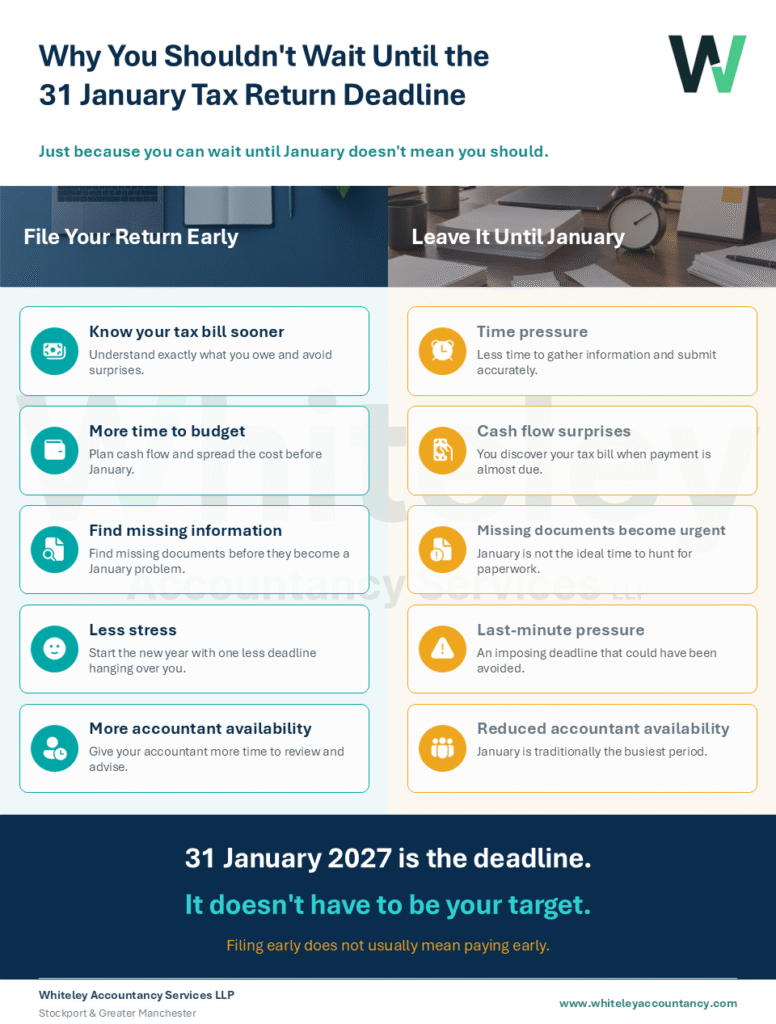
Filing Early Doesn’t Mean Paying Early
One of the biggest misconceptions surrounding Self Assessment is that submitting a tax return early means paying the tax immediately.
It doesn’t.
Once your tax return has been completed and submitted, you’ll know how much tax is due, but payment is generally still not required until 31 January 2027.
This means you can gain certainty about your tax position months in advance without bringing forward the payment date.
For many taxpayers, that’s reason enough to get their return completed.
Know Your Tax Bill Before the 31 January Deadline
Nobody enjoys unexpected bills.
One of the most significant benefits of filing your Self Assessment tax return early is understanding exactly what you’ll owe.
If you’ve had a particularly successful year in business, sold investments, received rental income or had multiple sources of income, your tax liability may be different from previous years.
Completing your return well before the 31 January tax return deadline gives you time to:
- Budget for the payment
- Set funds aside gradually
- Avoid nasty surprises after Christmas
There’s a huge difference between discovering a tax bill in November and discovering the same tax bill on 28 January.
More Time to Find Missing Information
A Self Assessment tax return needs accurate information to be gathered in order to prepare it.
Many delays occur not because the return itself is difficult, but because documents are missing.
Common examples include:
- Bank interest information
- Rental income records
- Pension contribution information
- Trading income records
- Expense records
- Dividend statements
- Investment documentation
Starting the process earlier gives you time to locate missing information and avoid last-minute scrambling.
If an accountant is preparing the return on your behalf, early engagement also allows much more time to deal with queries and requests for additional information.
Avoid the Rush of the 31 January Tax Return Deadline
I always expect January to be a quiet month.
It never is!
Businesses are getting back up to speed and starting new projects after the festive period, personal finances are often under pressure following Christmas and many people are focused on a fresh start to the year.
Adding a looming tax deadline to that list isn’t ideal.
One of the simplest benefits of filing early is peace of mind.
The closer the 31 January tax return deadline gets, the more pressure many taxpayers place on themselves unnecessarily.
Once your tax return has been submitted, it’s one less thing to think about during the final weeks before the deadline.
Many taxpayers tell themselves they’ll complete their return “after Christmas” only to find January disappears far more quickly than expected.
Avoid Last-Minute Technical Problems
Technology makes filing easier, but it doesn’t make deadlines disappear.
Every January there are people attempting to:
- Recover forgotten login details
- Access old email addresses
- Find their Government Gateway credentials
- Resolve account issues
- Submit returns at the last minute
Most issues can be resolved.
The problem is that they’re much less stressful when discovered in November than on the evening of 31 January.
Submitting early gives you additional time to deal with any unexpected administrative hurdles.
Give Your Accountant Time to Help
From an accountant’s perspective, the ideal tax return arrives well before January.
Unfortunately, many arrive during the busiest period of the year.
Submitting information early means:
- More time for questions and clarification
- Less pressure on everyone involved
- More opportunity to identify potential issues
- A smoother preparation process
If you work with an accountant, you’ll often receive a better experience by providing information early, rather than waiting until the January rush.
If You’re Due a Refund, You Could Receive It Sooner
Not every Self Assessment tax return results in additional tax to pay.
Some taxpayers discover that they have overpaid tax and are entitled to a repayment.
If that’s the case, completing your return early can start the repayment process sooner.
Waiting until January could mean leaving money sitting with HMRC that would be more useful in your own bank account.
While nobody should complete a tax return solely on the assumption that a refund is due, it’s another reason not to delay unnecessarily.
Why Do People Leave Tax Returns Until January?
Given all those great reasons for filing early, why do some still find themselves in that last minute panic every year?
Most people don’t deliberately choose unnecessary stress.
In our experience, tax returns often get delayed because:
- The deadline feels a long way away
- The taxpayer isn’t sure where to start
- Records haven’t been gathered yet
- There are unanswered questions
- Other priorities take over
The earlier you start, the more time you have to address these issues.
Time to Get Organised
If you haven’t started your 2025/26 Self Assessment tax return yet, now is an ideal opportunity.
Begin by gathering relevant records and confirming that you have information for all sources of income.
If you’re preparing the return yourself, consider what information might still be required.
If you’re working with an accountant, now is a good time to send over your records and discuss any questions.
Even if you don’t submit the return immediately, being organised now can make the process much easier later.
Don’t Let 31 January Become Your Target
The 31 January tax return deadline should be viewed as a safety net, not a goal.
Submitting your return earlier won’t normally accelerate the payment deadline, but it can provide greater certainty, improve cash flow planning and remove a significant task from your January to-do list.
Leaving your return too late also increases the risk of missing the deadline altogether and becoming subject to penalties.
Whether you’re self-employed, a landlord or someone with additional income requiring a Self Assessment tax return, there is rarely a disadvantage to getting organised early.
The real question isn’t:
“Why should I file early?”
It’s:
“What do I gain by waiting?”
For most taxpayers, the answer is very little.
Need help with your 2025/26 Self Assessment Tax Return?
If you’d like support preparing your 2025/26 Self Assessment tax return, our Self Assessment and tax return services can help ensure your return is submitted accurately and on time.
Getting started now could make January considerably less stressful.