
31 October Tax Return Deadline Approaching: Is It Time to File Your Self Assessment Online?
The 31 October tax return deadline for paper Self Assessment tax returns is almost here. If you still need to complete your 2025/26 tax return, now is the time to check how you plan to file it and, if necessary, make sure you are registered for Self Assessment.
Every year, some taxpayers focus on the 31 January online filing deadline and overlook the fact that the 31 October paper tax return deadline arrives much sooner.
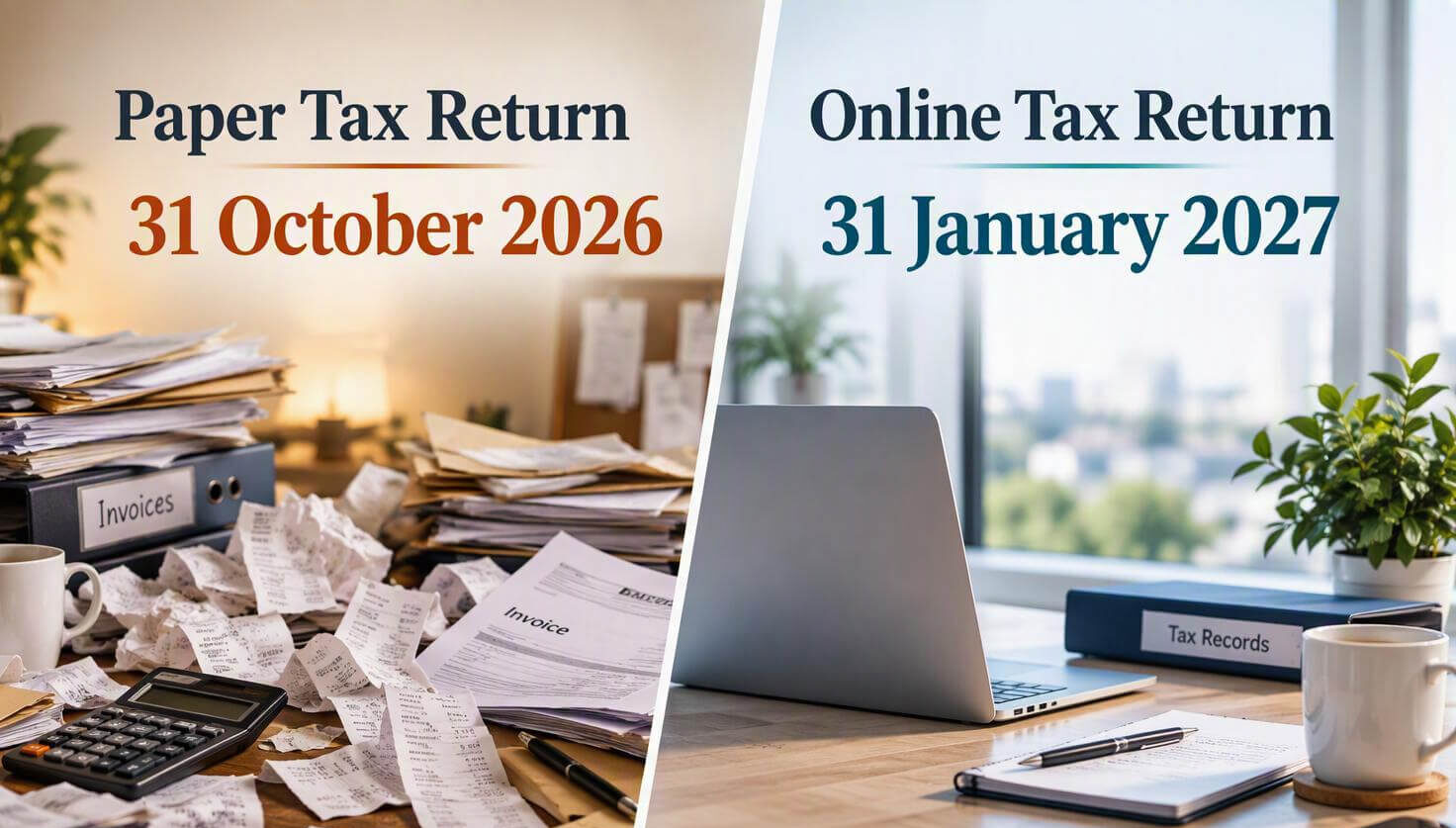
For people who still submit a paper tax return, the 31 October tax return deadline is an important date. HM Revenue & Customs (HMRC) must receive most paper Self Assessment tax returns for the tax year ending 5 April 2026 by 11:59pm on 31 October 2026.
If you file your Self Assessment online, however, the standard deadline is later: 11:59pm on 31 January 2027.
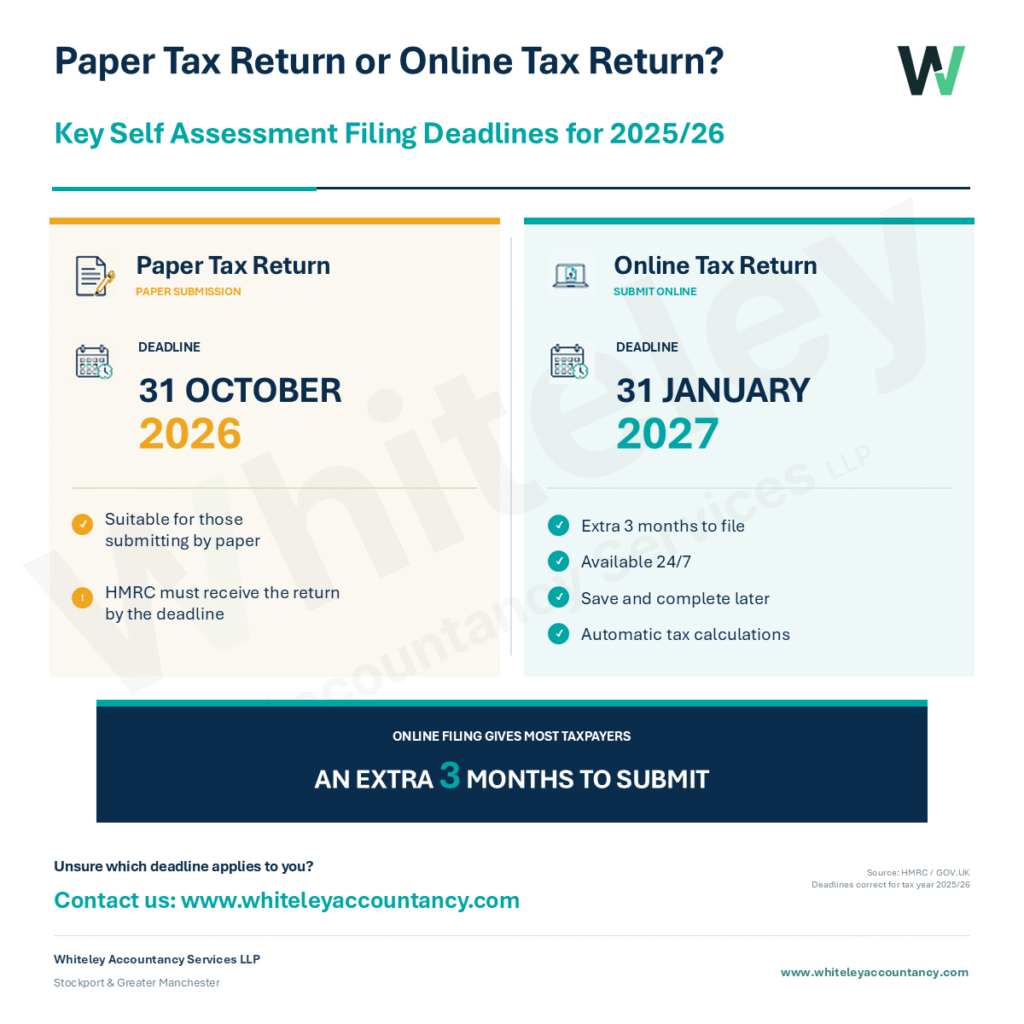
That extra three months is one of several reasons why filing online could make sense. HMRC’s own guidance for paper filers points out that online filing offers an extra three months, automatically calculates your tax and allows you to save a return and finish it later.
What are the 2025/26 Self Assessment Tax Return Deadlines?
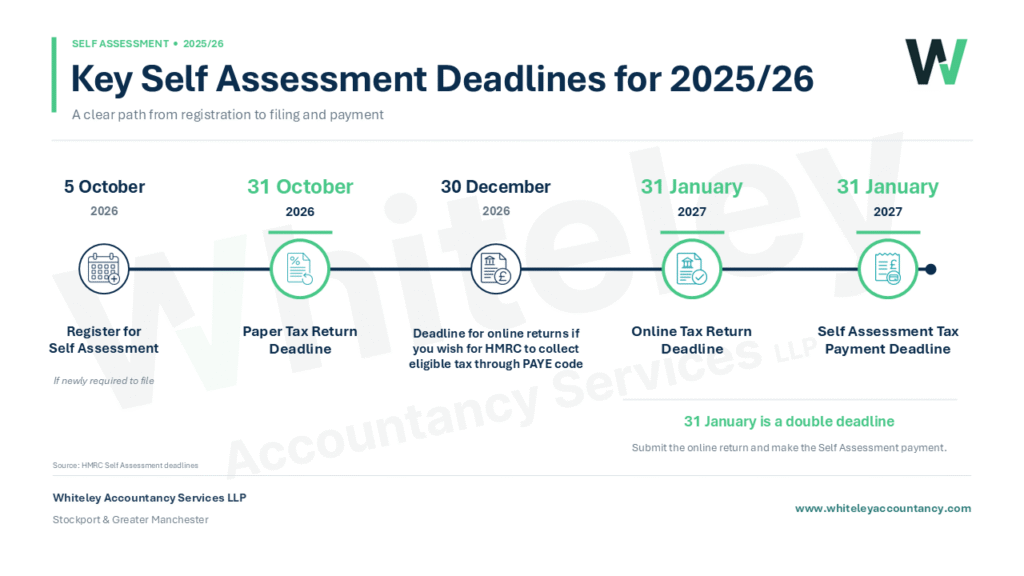
For the 2025/26 tax year, which ran from 6 April 2025 to 5 April 2026, HMRC’s standard deadlines are:
- 5 October 2026: the date by which certain taxpayers who need to complete a return had to tell HMRC.
- 31 October 2026: the deadline for HMRC to receive most paper Self Assessment tax returns.
- 30 December 2026: the online filing deadline if you want HMRC to collect eligible Self Assessment tax through your PAYE tax code.
- 31 January 2027: the standard deadline to submit an online Self Assessment tax return.
- 31 January 2027: the deadline to pay the Self Assessment tax you owe.
So, if you have been planning to complete a paper return but haven’t yet done so, there isn’t much time left before the 31 October tax return deadline.
Also note that HMRC must receive your paper return by 11:59pm on 31 October. It isn’t enough simply to put it in the post on that day.
The good news is that HMRC’s own guidance says that if you decide to complete your tax return online instead, or miss the paper deadline, you can submit it online by 31 January 2027.
That could give you significantly more breathing room.
Haven’t registered for Self Assessment yet?
Before worrying about whether to file on paper or online, make sure you’re actually registered if you need to be.
HMRC says you needed to tell them by 5 October 2026 if you need to complete a return for 2025/26 and you either:
- have not sent a tax return before, or
- have registered previously but did not need to send a tax return for 2024/25.
The way to tell HMRC that you need to complete a return is by registering for Self Assessment.
Of course, as I write this, 5 October has already passed.
If you have only just realised that you need to complete a tax return and haven’t yet registered for Self Assessment, don’t treat that as a reason to leave the problem until January.
What happens if I’ve missed the 5 October deadline to register for Self Assessment?
HMRC says that telling them after 5 October 2026 could result in a penalty. HMRC will send late registrants a letter or email containing a different filing deadline, which will be three months from the date of that communication. Tax owed must still be paid by 11:59pm on 31 January 2027 to avoid a penalty.
In other words, missing the registration date doesn’t mean ignoring Self Assessment until the next deadline. It makes dealing with your position now more important.
Have you used Self Assessment before?
There’s another situation worth checking.
Perhaps you’ve completed a Self Assessment tax return in the past, but didn’t need to submit one last year.
HMRC says that people who have previously registered for Self Assessment but didn’t send a tax return for 2024/25 may need to reactivate their Self Assessment account. HMRC also warns that a return may be delayed if it is filed without reactivating an existing account when reactivation is required.
It’s one more reason not to assume that everything will simply be ready when you log in to file your return in January.
Why consider filing your Self Assessment online?
The most obvious difference is the deadline.
Submit using a standard paper tax return and, for most people, HMRC needs to receive it by 31 October 2026.
File online and the standard deadline becomes 31 January 2027.
But the later deadline isn’t the only benefit.
HMRC highlights several advantages of sending a Self Assessment tax return online. Its current guidance says that online filing:
- is available 24 hours a day;
- gives you an extra three months to submit compared with the standard paper deadline;
- allows you to save your details and finish the return later;
- calculates your tax automatically;
- can result in a quicker repayment if you are due one; and
- allows you to receive messages through your online account.
HMRC’s 2026 tax return documentation also describes filing online as quick, easy and secure.
For someone currently looking at a rapidly approaching paper deadline, the additional filing window alone may make online filing particularly attractive.
What if you miss the 31 October tax return deadline?
This is where the distinction between paper and online filing is especially useful.
HMRC’s guidance explicitly says that if you decide to complete your return online or miss the paper deadline, you must submit the return online by 31 January 2027.
That makes the period around 31 October a sensible point to review how you intend to file.
It is also worth remembering that these filing dates should not be confused with the deadline for paying your tax.
The standard deadline for paying the Self Assessment tax you owe for 2025/26 is 11:59pm on 31 January 2027.
And there is one more date that can matter for some taxpayers. If you owe tax to HMRC and want them collect it through your PAYE tax code, the online return needs to be submitted by 11:59pm on 30 December 2026. If that filing deadline is missed, HMRC says you will need to pay another way.
So although 31 January receives most of the attention, it certainly isn’t the only Self Assessment date worth knowing.
Can everyone submit a Self Assessment tax return online?
Online filing is not available for every return, so it’s important not to assume that the 31 January online deadline applies in exactly the same way to everybody.
HMRC specifically states that trustees of registered pension schemes and non-resident companies cannot send their return online. For these taxpayers, HMRC must receive their paper tax return by 31 January 2027.
If you’re unsure which filing method applies to your circumstances, check the relevant HMRC requirements or take advice rather than relying on the general 31 October and 31 January deadlines.
What should you do before 31 October?
If your 2025/26 tax return is still outstanding, there are a few questions worth answering now:
Do you actually need to submit a Self Assessment return?
HMRC provides a service to check whether you need to send one, so establish your position rather than assuming that you do, or don’t, need to file.
If you need to file, are you registered?
If this is your first return, or you were previously registered but didn’t need to file for 2024/25, check your registration position now. The 5 October date has already passed and HMRC says late notification could result in a penalty.
Were you previously registered?
Check whether your Self Assessment account needs to be reactivated.
Were you planning to file on paper?
Remember that HMRC must receive most paper returns by 31 October 2026. If you decide to file online instead, the standard online deadline is 31 January 2027.
Have you started gathering your records?
HMRC says taxpayers need to keep records, such as bank statements or receipts, so they can complete their return correctly.
Getting those points straight now can prevent the Self Assessment process becoming an unpleasant January surprise.
Having until January doesn’t mean waiting until January
Switching to online filing might buy you more time, but there’s a big difference between having more time and needing to use all of it.
HMRC points out that once you’ve registered, you can submit your return at any time after 5 April and that doing it earlier means you’ll know what you owe.
That matters because completing your return does more than tick an administrative box. Knowing your tax position earlier gives you a clearer picture of what will need to be paid by the January deadline and gives you time to save up if you haven’t already reserved the cash to settle any outstanding tax liability.
If the approaching 31 October tax return deadline encourages you to move from a paper Self Assessment return to filing online, don’t simply move the task from your October to-do list onto your January one.
Use the additional time to get organised and get ahead.
In our next post, we’ll look at why filing your Self Assessment return before the 31 January tax return deadline could save you time, stress and unexpected surprises.
Need help with your 2025/26 Self Assessment Tax Return?
The different dates around Self Assessment registration, paper tax returns and online filing can be confusing, particularly if this is your first return or your circumstances have changed since you last filed.
If you’re unsure whether you need to register, which deadline applies to you, or what you need to complete your 2025/26 Self Assessment tax return, speak to the team at Whiteley Accountancy Services.
The key message as the 31 October tax return deadline approaches is simple: don’t wait until January to discover there’s a problem. Check your Self Assessment position now.